
Ohio BMV Permit Practice Test 9
Test 9 of 10. Pick an answer for each question to see if it is right and why; your score appears at the end. You need 30 correct answers to pass, the same ratio as the real Ohio test.
- Questions40
- Correct to pass30
- Passing score75%
- Minimum age15 years 6 months
-
1. What is the fine range a court must impose for a standard first-time OVI conviction in Ohio?
Show answer
Answer B: $565 to $1,075
Ohio law sets the fine for a first OVI conviction at not less than $565 and not more than $1,075.
-
2. During a stop for distracted driving in Ohio, may a law enforcement officer search the driver's electronic device without a warrant?
Show answer
Answer B: No, unless the driver voluntarily and unequivocally consents
Ohio law bars an officer from accessing a driver's device during a distracted-driving stop without a warrant unless the driver voluntarily and unequivocally consents.
-
3. Traffic is backed up just past the exit you want to use at a single-lane roundabout. What should you do?
Show answer
Answer D: Wait at the yield line until you can pass through and exit
You must not enter a roundabout unless you can clear it, because stopping inside blocks every other entry.
-
4. For a standard first-time Ohio OVI suspension, how many days must generally pass before a court may grant the offender any limited driving privileges?
Show answer
Answer D: 15 days
For a standard first OVI suspension, Ohio courts generally may not grant limited driving privileges during the first 15 days, after which privileges may be allowed, often with an ignition interlock requirement.
-
5. You are following a large truck on a two-lane road and cannot see past it. What should you do before deciding to pass?
Show answer
Answer D: Drop back so that your view of the road ahead opens up
Distance is what buys you a view around a large vehicle, and no decision to pass can be made from a position where you cannot see.
-
6. You are involved in a collision, even a minor one. What is your first legal duty?
Show answer
Answer A: Stop at or near the scene without blocking traffic more than necessary
Every driver involved in a crash must stop at the scene, and leaving before meeting that duty is a serious offense. Move the vehicles only as far as needed to clear the traffic lanes.
-
7. A pedestrian waiting at a curb faces a steady upraised hand. What does that indication mean?
Show answer
Answer A: Do not start to cross in that direction
A steady upraised hand forbids entering the crosswalk, while a flashing hand only forbids starting a new crossing.
-
8. Under Ohio's TIPIC restrictions, may a permit holder of any age use a mobile electronic device while practice driving?
Show answer
Answer C: Yes, but only to make emergency calls or use navigation
Ohio's TIPIC restrictions prohibit the use of any mobile electronic device while driving, and this ban applies to permit holders of every age, not just those under 18.
-
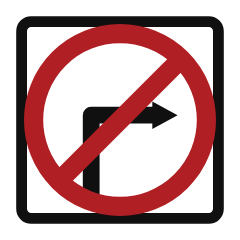
9. A driver stopped at a red signal wants to turn right and this sign is posted at the corner. What is permitted?
Show answer
Answer A: Nothing: the turn is barred whether the signal is red or green
The restriction works independently of the signal, so the usual permission to turn right after stopping at a red light does not exist where this sign is posted.
-
10. The divided highway ends warning sign means that
Show answer
Answer D: the median separating the directions ends and the road returns to two-way operation
Beyond this sign opposing traffic is no longer separated by a median, so the driver must keep right and expect vehicles approaching in the adjacent lane.
-
11. You are pulling out of a farm entrance onto a rural highway. What is your obligation?
Show answer
Answer C: Yield to every vehicle already on the highway before you enter the roadway
A driver entering a highway from a private road or driveway yields to every vehicle already on the highway.
-
12. You face a red light at an intersection that has no stop line and no marked crosswalk. Where must you stop?
Show answer
Answer C: Before entering the intersection
With no line and no crosswalk, the stopping point is the near edge of the intersecting roadway, close enough to see cross traffic but clear of it.
-
13. On a two-way street, where and how should you park at the curb?
Show answer
Answer C: On the right side, facing the way traffic moves
On a two-way street you must park on the right, headed in the direction of travel; parking facing traffic is prohibited.
-
14. The tire pressure monitoring symbol lights up on your dashboard. What is the system telling you?
Show answer
Answer A: At least one tire is significantly underinflated
The system warns when a tire falls well below the recommended pressure. Check all four with a gauge and inflate to the placard figure while they are cold.
-
15. A regulatory sign reads TURN ON HEADLIGHTS NEXT 15 MILES. What does it require?
Show answer
Answer C: Low beam headlights on for that stretch, day or night
Such a section is signed where a road is hard to see along, and the requirement is to run headlights, not just daytime running lamps, through the whole stretch even in bright daylight.
-
16. After passing the Ohio knowledge test, how long does an applicant have to buy a Temporary Instruction Permit Identification Card before having to start over?
Show answer
Answer C: 60 days
Ohio gives the applicant 60 days to visit a Deputy Registrar License Agency and purchase the TIPIC; after that the vision screening and knowledge test must be repeated.
-
17. Under Ohio law, an opened bottle of wine purchased at a restaurant can avoid being treated as an open container in a vehicle if what two conditions are met?
Show answer
Answer C: It is securely resealed with visible tamper evidence and stored in the trunk or behind the last seat
Ohio law treats a resealed wine bottle as something other than an open container only if it is securely resealed in a tamper-evident way and stored in the trunk, or behind the last upright seat if there is no trunk.
-
18. Which shape is used for the school advance warning sign and the school crossing sign?
Show answer
Answer B: An upward-pointing pentagon
The five-sided pentagon with its point up identifies school signing, so the outline alone tells a driver that children may be present.
-
19. Small green signs with white numerals posted at regular intervals along a highway are used to
Show answer
Answer B: show distance along the route and give a reference point for reporting a location
Reference location signs, commonly called mileposts, carry white numerals on green and let a driver describe exactly where a breakdown or crash has occurred.
-
20. You are approaching a highway-rail grade crossing marked only with a crossbuck sign. What does that sign require?
Show answer
Answer A: Yield to any approaching train and cross only when the tracks are clear
The crossbuck is a regulatory yield sign, and a train can never stop or steer around a vehicle, so the driver must always give way.
-
21. The posted limit is 55 mph, but heavy traffic and rain make that speed unsafe. What does the law expect of you?
Show answer
Answer D: You must slow to a speed that is safe for the conditions
The basic speed rule requires a speed that is reasonable for the traffic, weather and road, and that speed is often well below the posted maximum.
-
22. You make eye contact with a driver waiting to pull out of a side street. What should you assume?
Show answer
Answer D: The driver may still not have seen you, so stay ready to slow or stop
Drivers can look directly at you and still not register your vehicle, especially a small one. Eye contact helps, but never rely on it.
-
23. What is Ohio's speed limit on a state route or through highway inside a municipal corporation but outside a business district?
Show answer
Answer D: 35 miles per hour
Ohio law sets 35 mph as the prima facie limit for state routes and through highways within a municipal corporation outside business districts.
-
24. You come around a bend and find loose sand spread across your lane. What should you do?
Show answer
Answer D: Ease off the gas, avoid sudden braking or steering, and keep straight
Loose material acts like ball bearings under the tires; smooth inputs preserve what little grip remains, while sudden braking or steering breaks it.
-
25. How should the outside mirrors be aimed to reduce your blind spots?
Show answer
Answer A: Outward, so each one covers the lane beside you rather than repeating the inside mirror
Mirrors aimed too far inward show you the same road three times and leave a large gap beside the vehicle, so aiming them outward shrinks the blind spot.
-
26. What are front fog lights for?
Show answer
Answer D: Adding a low, wide beam close to the car when visibility is poor
Fog lights throw a low, wide beam under the fog, which is why they are mounted low and are used only in poor visibility.
-
27. Where in the United States may a motorcycle ride between lanes of traffic?
Show answer
Answer C: Only where a state has specifically authorized it
Riding between lanes is prohibited in most states and permitted only where a state law expressly allows it, so a rider must know the rule for the state being ridden in.
-
28. An Ohio first-time distracted-driving offender wants to attend a safety course instead of paying the fine and having points assessed. Within how many days of the violation must the offender submit proof of completion to the court?
Show answer
Answer B: 90 days
An Ohio first-time offender who completes the distracted driving safety course must submit written proof to the court within 90 days of the violation to avoid the fine and points.
-
29. What should you expect while driving through a parking lot?
Show answer
Answer D: Pedestrians and vehicles moving from any direction, so drive slowly
Parking lots mix walking people, reversing vehicles and poor sight lines, so low speed and constant scanning are the only reliable protection.
-
30. The driver ahead of you is straddling the lane line and is not signaling. How should you respond?
Show answer
Answer B: Stay back until you can see which lane that driver will take
A vehicle astride the line could move either way, so the only safe place is behind it where both possibilities are still covered.
-
31. Where is a U-turn generally the most reasonable choice?
Show answer
Answer B: At an intersection where it is permitted and you can see well both ways
A U-turn needs a legal place and a long clear view in both directions, which is why a permitted intersection with open sight lines is the usual choice.
-
32. You are parking on a hill where there is no curb, whether facing up or down. Which way should the front wheels point?
Show answer
Answer B: Toward the shoulder, so the vehicle would roll away from the traffic lanes
With no curb to stop the vehicle, the wheels are turned toward the edge of the road so that a runaway vehicle leaves the roadway instead of entering it.
-
33. Enhanced reference location markers differ from ordinary mileposts in that they
Show answer
Answer B: carry the route number and a mileage figure to the tenth of a mile
An enhanced reference location marker adds the route designation and carries the mileage to a tenth, so the point named is far more precise than a plain milepost.
-
34. You are driving along a street lined with parked cars. What should you watch for?
Show answer
Answer B: Doors opening, vehicles pulling out and pedestrians stepping from between cars
Parked cars hide people and can move without warning. Keep as much space from them as you safely can and cover the brake.
-
35. What is Ohio's speed limit on a state route within a municipal corporation that lies outside an urban district, absent a lower posted limit?
Show answer
Answer A: 50 miles per hour
Ohio law sets 50 mph on state routes within a municipal corporation outside an urban district unless a lower limit is established.
-
36. An Ohio driver refuses a chemical test after an OVI arrest with no prior refusals or convictions. How long is the administrative license suspension?
Show answer
Answer B: One year
A first refusal in Ohio brings a one-year administrative license suspension, while a first test over the limit brings a 90-day suspension.
-
37. What must you be sure of before you pull out to pass on a two-lane road?
Show answer
Answer A: That the road ahead is clear far enough for the whole pass
You need enough clear road to pull out, pass and return before any oncoming vehicle arrives, and you must judge that distance before you start.
-
38. How many questions does the Ohio knowledge test contain and what share must be answered correctly?
Show answer
Answer A: 40 questions, with 75 percent correct
The Ohio Driver Manual sets the knowledge test at 40 multiple-choice questions and requires a 75 percent passing rate, which is 30 correct answers.
-
39. You are in a marked passing zone but a steady stream of oncoming traffic is coming toward you. What does the broken center line allow?
Show answer
Answer C: A pass only when the road is clear, so you have to stay behind
A passing zone marks where the sight distance is adequate, but it never gives permission to enter a lane that another vehicle is occupying.
-
40. How much following distance should you keep behind a motorcycle?
Show answer
Answer C: At least three to four seconds
A motorcycle can slow or stop very quickly and is easily upset by a surprise, so allow three to four seconds instead of the usual car gap.