
Ohio BMV Permit Practice Test 2
Test 2 of 10. Pick an answer for each question to see if it is right and why; your score appears at the end. You need 30 correct answers to pass, the same ratio as the real Ohio test.
- Questions40
- Correct to pass30
- Passing score75%
- Minimum age15 years 6 months
-
1. You find yourself in a lane that must turn, you wanted to go straight, and you cannot change lanes safely. What should you do?
Show answer
Answer D: Make the required turn and find another route
Going straight from a mandatory turn lane surprises everyone around you, while a wrong turn costs only a few extra minutes.
-
2. What is the proper use of the horn?
Show answer
Answer C: To give a brief warning when another road user may not have seen you
The horn is a warning device meant to alert someone to your presence when a collision is possible, and using it in anger tends to escalate conflict rather than prevent crashes.
-
3. Lights set into the pavement along both edges of a crosswalk start to flash yellow as you approach. What do they tell you?
Show answer
Answer D: Someone is crossing and has to be given way
In-roadway warning lights flash only when a pedestrian activates the crossing, so a flashing pattern means somebody is in or entering the crosswalk.
-
4. What is the main limit of stability and traction control systems?
Show answer
Answer B: They cannot create grip that the tires and the road do not have
These systems manage the grip that exists. If you enter a curve too fast for the surface, no amount of electronics will hold the vehicle on the road.
-
5. In Ohio, how many BMV points are assessed for a speeding conviction when the speed exceeds the posted limit by 30 miles per hour or more?
Show answer
Answer C: 4 points
Ohio assesses 4 points whenever a speeding conviction involves exceeding the posted limit by 30 mph or more, regardless of the zone's own limit.
-
6. What is meant by keeping a space cushion?
Show answer
Answer C: Keeping open space on all sides of your vehicle so you always have somewhere to go
Open space ahead, behind and to the sides gives you time to react and an escape path when a hazard appears, which is the core idea of defensive driving.
-
7. An Ohio applicant aged 21 or older fails the driving test on the first attempt. What must happen before a second attempt?
Show answer
Answer B: Completion of an Abbreviated Adult Driver Training Course, unless approved driver education was taken within the past year
Ohio requires an applicant aged 21 or older who fails the maneuverability or road skills test to complete an Abbreviated Adult Driver Training Course before retesting, unless approved driver education was completed within one year before the test.
-
8. An Ohio driver's vehicle is damaged in excess of $400 in a crash, and the other driver had no insurance. Within how long after the crash may this driver file a BMV Crash Report, form BMV 3303, documenting that fact?
Show answer
Answer B: Six months
Ohio allows a driver to file a Crash Report with the Bureau of Motor Vehicles within six months after a crash when damage exceeds $400 or there is personal injury, and the other party lacked insurance.
-
9. Which of the four blind spots around a tractor-trailer is the largest?
Show answer
Answer A: The one on the right side of the truck
A truck has no-zones on all four sides, and the right-side blind spot is the largest because it runs back along the trailer and reaches across more than one lane.
-
10. How does a lap and shoulder belt protect you in a crash?
Show answer
Answer B: It holds you to the seat and spreads the force over the strong bones
The belt keeps you with the vehicle as it slows and puts the load on the hips and the chest rather than on soft tissue.
-
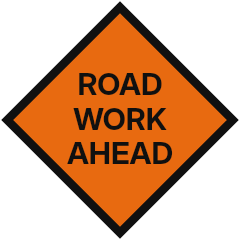
11. Beyond this sign, cones and temporary signs lead traffic along a path that does not agree with the lines painted on the pavement. Which one must the driver follow?
Show answer
Answer C: The temporary arrangement, because it replaces the permanent layout while the work lasts
Temporary traffic control set up for the work takes precedence over the permanent signs and markings, which no longer describe how the road is being used.
-
12. How long does a parallel parking space need to be for the car you are driving?
Show answer
Answer D: About five or six feet longer than your vehicle
A few extra feet at each end give you the room to swing in and to straighten up without touching the vehicles in front or behind.
-
13. In which situation should you increase your usual following distance?
Show answer
Answer B: On wet roads, at night, in fog, when towing a trailer, or when following a motorcycle
Reduced traction, reduced visibility, a heavier load and a vehicle that can stop faster than yours all require extra space to keep the same margin of safety.
-
14. Under Ohio's TIPIC restrictions, what limits the number of occupants a permit holder may carry in the vehicle?
Show answer
Answer A: The total occupants cannot exceed the number of safety belts installed in the vehicle
Ohio's TIPIC restrictions cap the total number of vehicle occupants at the number of safety belts originally installed in the vehicle.
-
15. A yellow diamond showing the silhouette of a deer warns that
Show answer
Answer D: large animals may cross the road in that area
The sign marks a stretch where animals are known to cross, so drivers should reduce speed and scan both roadsides, especially around dawn and dusk.
-
16. You are about to pass a long tractor-trailer on a two-lane road. What should you expect?
Show answer
Answer B: You will need more clear road, since the vehicle is much longer
A tractor-trailer can be 70 feet long, so passing it takes more distance and more time than passing a car at the same speed difference.
-
17. Loose gravel has been swept into the middle of your lane on a downhill bend. Which controls are affected most?
Show answer
Answer D: Steering and braking, since the loose stones roll under the tires
Gravel rolls between rubber and pavement, so the tires can neither turn the vehicle nor slow it as they would on a clean surface.
-
18. During which period are studded tires legal in Ohio?
Show answer
Answer B: November 1 through April 15
Ohio permits studded tires only from November 1 through April 15.
-
19. Your vehicle is stuck in deep snow and you run the engine for heat while waiting for help. What must you check?
Show answer
Answer C: That the exhaust pipe is clear of snow
Snow packed around the tailpipe pushes exhaust back into the cabin, and carbon monoxide can kill without warning. Clear the pipe and crack a window open.
-
20. What does a booster seat do for a child?
Show answer
Answer B: It lifts the child so that the adult belt crosses hips and shoulder
A booster raises the child so the adult belt lies on the strong parts of the body instead of the neck and the abdomen.
-
21. How many BMV points does a second distracted-driving offense within a two-year period carry in Ohio?
Show answer
Answer C: 3 points
Ohio's point schedule assesses 3 points for a second distracted-driving conviction within a two-year period, one more than the first offense and one less than the third.
-
22. You decide to turn around using a driveway on your right. What is the safer way to do it?
Show answer
Answer C: Stop past the driveway, reverse into it, then pull out and drive away
Passing the driveway and backing in means you reverse off the roadway and then rejoin traffic facing forward, with a full view of both directions.
-
23. About how far ahead do low beam headlights let you see on a dark road?
Show answer
Answer B: About 250 feet
Low beams light roughly 250 feet of road, and high beams roughly 350 to 500 feet, which sets the limit on a safe night speed.
-
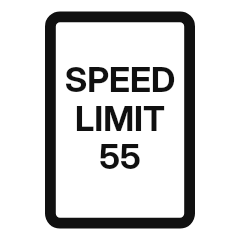
24. A driver passes this sign on an open road. Over what stretch does the figure it sets stay in force?
Show answer
Answer A: From the sign onward, in every lane, until another sign sets a different figure
The figure governs the road from the sign onward and binds every lane, and it stays in force until a later sign sets a different one.
-
25. For a standard first-time OVI conviction in Ohio, what is the mandatory minimum jail term, and what alternative may a court substitute for it?
Show answer
Answer A: 3 consecutive days in jail, or a 3-day driver intervention program
Ohio requires a mandatory minimum of three consecutive days in jail for a standard first OVI conviction, but a court may substitute three days in a certified driver intervention program instead.
-
26. When is switching traction control off sometimes useful?
Show answer
Answer A: When you need spinning wheels to rock out of deep snow or mud
Rocking a stuck vehicle free needs the wheel spin that the system normally prevents. Switch it back on as soon as you are moving again.
-
27. A white regulatory sign near a state line reads BUCKLE UP IT IS THE LAW. What is it doing?
Show answer
Answer A: Reminding occupants that belt use is required
The safety belt sign restates a law that already applies, and it is usually placed where drivers enter a state or a long rural stretch.
-
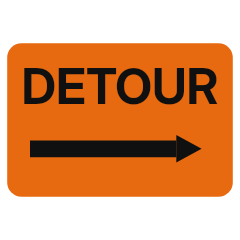
28. Once a driver has joined the route this sign begins, how is the rest of the way marked?
Show answer
Answer B: By further markers of the same kind at each turn, until the original road is rejoined
The alternate route is signed continuously, with a marker at every turn, so a driver with no local knowledge can follow it back to the original road.
-
29. An Ohio probationary driver under 18 is convicted of a traffic offense soon after getting a license. What consequence can follow regarding parental accompaniment?
Show answer
Answer D: A parent or legal guardian may be required to accompany the driver for six months, or until the driver turns 17
Ohio law allows a traffic offense conviction soon after licensure to trigger a requirement that a parent or legal guardian accompany the young driver for six months, or until the driver reaches age 17, whichever applies.
-
30. A piece of farm machinery ahead of you is wider than its own lane. What should you do?
Show answer
Answer C: Hold back until you can see far enough to pass safely
Wide equipment leaves no gap inside the lane and may use part of the other side, so a pass needs a long clear view of the road ahead.
-
31. What is the main function of the guide sign series?
Show answer
Answer D: To identify routes and lead road users to their destinations
Guide signs identify routes, name destinations and give distances, so drivers can navigate without stopping to consult a map.
-
32. You are waiting in a center two-way left-turn lane. What should you expect from oncoming traffic?
Show answer
Answer A: Oncoming drivers may enter the same lane to prepare their own left turns
Both directions share a two-way left-turn lane, so an oncoming vehicle may be waiting in it and you must never treat it as yours alone.
-
33. How many BMV points does a conviction for operating a vehicle in willful or wanton disregard of the safety of persons or property carry in Ohio?
Show answer
Answer B: 4 points
Ohio's reckless operation offense, defined as driving in willful or wanton disregard for safety, carries 4 points.
-
34. Which of these is announced with the same family of signs as the facility shown here?

Show answer
Answer A: A rest area for travelers
A rest area belongs to the same motorist service series, which points travelers toward facilities such as fuel, food, lodging and medical care.
-
35. Your light turns green, but a vehicle is still in the middle of the intersection. What should you do?
Show answer
Answer D: Wait until the intersection is clear before you move ahead
A green light means go only when the way is clear. Drivers already inside the intersection must be allowed to finish crossing.
-
36. A wasp flies in through the open window while you are driving. What is the safest reaction?
Show answer
Answer B: Stay calm, slow down and stop somewhere safe
Far more crashes come from the driver's reaction to an insect than from the insect, so keep your eyes forward, slow down and deal with it stopped.
-
37. What must a driver be ready to do along the stretch of road where this sign is posted?

Show answer
Answer D: Slow down and stop for a child who steps into the roadway
Children misjudge speed and distance and act without warning, so the driver reduces speed, covers the brake and scans the sidewalks and parked vehicles.
-
38. What must accompany an Ohio TIPIC application from an applicant who is under age 18?
Show answer
Answer B: The co-signature of a parent or guardian on the application
An Ohio TIPIC applicant under age 18 must have a parent or guardian present to co-sign the permit application.
-
39. What penalty may an Ohio court impose for a third or subsequent distracted-driving offense within two years?
Show answer
Answer A: A fine of up to $500 and a possible 90-day license suspension
For a third or subsequent distracted-driving offense within two years, Ohio law allows a fine of up to $500 and permits the court to suspend the offender's license for 90 days.
-
40. You are driving on a two-lane road approaching the crest of a hill. Where should you position your vehicle?
Show answer
Answer D: Toward the right side of your lane, in case an oncoming vehicle is over the center line
You cannot see what is beyond a crest, and oncoming drivers sometimes drift across the center. Keeping right and slowing gives you a margin.