
Ohio BMV Permit Practice Test 8
Test 8 of 10. Pick an answer for each question to see if it is right and why; your score appears at the end. You need 30 correct answers to pass, the same ratio as the real Ohio test.
- Questions40
- Correct to pass30
- Passing score75%
- Minimum age15 years 6 months
-
1. The circular sign shape is reserved for which warning?
Show answer
Answer C: Advance warning of a highway-rail grade crossing
A round yellow sign with a black X and the letters RR is the grade crossing advance warning sign, and the circular outline is used for no other message.
-
2. On traffic control devices, the color green shows direction to a destination and also shows
Show answer
Answer C: that a movement is permitted
Green carries two assignments: guidance toward destinations, and the idea that the movement shown is allowed, as on a green arrow.
-
3. You are passing a tractor-trailer on a wet freeway and its wheels throw heavy spray. What is the best technique?
Show answer
Answer B: Increase your wipers and pass steadily without hesitating
Spray blinds you for as long as you stay beside the truck, so prepare the wipers first and then spend as little time in the spray as possible.
-
4. What is Ohio's speed limit in a school zone during recess and while children are arriving at or leaving school, when 20 mph school zone signs are posted?
Show answer
Answer A: 20 miles per hour
Ohio law sets a 20 mph prima facie speed limit in posted school zones during recess and the opening and closing hours when children are present.
-
5. What fine does Ohio law set for a driver cited for not wearing a seat belt?
Show answer
Answer C: $30
Ohio Revised Code 4513.263 sets a $30 fine for a driver who fails to wear all available elements of a properly adjusted seat belt.
-
6. Two lanes at the corner are marked for right turns. What does that require of you?
Show answer
Answer A: Keep your own lane through the turn and into the matching new lane
Dual turn lanes work only if each vehicle stays in its own lane all the way round and finishes in the corresponding lane of the new street.
-
7. How many BMV points does a conviction for operating a vehicle under the influence carry in Ohio?
Show answer
Answer B: 6 points
Ohio assesses 6 points, the maximum single-offense total, against a driver convicted under the state's OVI law.
-
8. Under Ohio's open container law, which passenger is exempt from the general ban on possessing an open container in a moving vehicle?
Show answer
Answer B: A chauffeured limousine passenger who is not seated in the front compartment where the operator sits
Ohio's open container law exempts a person riding in a chauffeured limousine under a prearranged contract, so long as that person is not occupying a seat in the front compartment where the limousine's operator sits.
-
9. What is Ohio's speed limit on a freeway with paved shoulders located inside a municipal corporation?
Show answer
Answer B: 55 miles per hour
Ohio sets 55 mph as the prima facie limit for freeways with paved shoulders inside a municipal corporation, apart from certain congested or outerbelt sections.
-
10. If you must abandon a vehicle stuck on the tracks with a train coming, why do you move toward the train and away at an angle?
Show answer
Answer D: Because debris from the impact is thrown forward, away from the train
A train pushes wreckage down the track ahead of it, so walking toward the train and off to the side keeps you out of the debris path.
-
11. The queue for an exit ramp has backed up into the right lane of the highway. What should you do if you want that exit?
Show answer
Answer B: Join the back of the queue in the lane instead of cutting in later
Passing a queue and forcing in at the front stops the whole line, and using the shoulder puts you where broken-down vehicles are expected to be.
-
12. Which practice matches current child passenger safety guidance?
Show answer
Answer D: Keep a child rear facing until the top height or weight limit of the seat is reached
A rear facing seat spreads crash forces across the child's whole back, so it should be used as long as the seat allows, and never in front of an active passenger air bag.
-
13. Beyond sunset-to-sunrise hours, when does Ohio law require a driver to turn on headlights based on visibility distance?
Show answer
Answer D: Whenever natural light does not allow objects to be clearly seen 1,000 feet ahead
Ohio law requires headlight use whenever natural light conditions do not allow a driver to clearly see objects 1,000 feet ahead, in addition to the sunset-to-sunrise and precipitation-related triggers.
-
14. You are about to slow down sharply for a turn. Which check comes first?
Show answer
Answer A: A look in the mirror to see how close the traffic behind you is
Any hard slowing needs a mirror check first, because the driver behind is the one who has to react to it.
-
15. The crossbuck, formed by two rectangular arms crossed in an X, is placed
Show answer
Answer D: on each highway approach to a railroad grade crossing
The crossbuck marks the location of a highway-rail grade crossing and is required on each highway approach to that crossing.
-
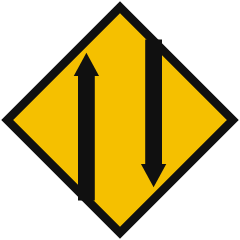
16. What is a driver being warned about here?
Show answer
Answer B: The pavement ahead carries vehicles traveling in the opposite direction
Beyond this point vehicles come the other way on the same pavement, which commonly happens where a one-way section or a separated stretch comes to an end.
-
17. A driver extends the left arm out the window and points it downward toward the road surface. What is being signaled?
Show answer
Answer A: Slowing down or stopping
The left arm extended downward is the standard hand signal for slowing or stopping.
-
18. How should a long trip be broken up to keep the driver alert?
Show answer
Answer D: Stop for a break every couple of hours and share out the driving
Regular breaks and a change of driver are the only reliable answers to fatigue; caffeine only postpones it.
-
19. Why is an underinflated tire especially risky on a long drive in hot weather?
Show answer
Answer C: It flexes more, builds up heat and can fail at speed
A soft tire flexes on every rotation, and that flexing makes heat that the hot road and high speed add to until the tire can come apart.
-
20. A bicyclist is riding in the middle of a narrow travel lane ahead of you. What is the correct response?
Show answer
Answer D: Slow down and wait until you can pass with wide clearance, changing lanes if needed
A bicyclist has the same right to use the lane as a driver, and a narrow lane may not leave safe passing room, so wait for a gap that lets you move over and pass with a wide margin.
-
21. Why is it useful to watch the vehicle two or three places ahead of you?
Show answer
Answer C: You get an earlier warning of slowing traffic than brake lights give
Trouble travels back through a line of traffic, so seeing it start several vehicles ahead gives you a head start on braking.
-
22. A pedestrian signal displays a steady walking person symbol. What does it mean for a pedestrian at that corner?
Show answer
Answer B: The pedestrian may start crossing in the direction of the signal
The steady walking person permits a pedestrian to begin the crossing, while still yielding to vehicles already lawfully in the intersection.
-
23. A sign at the start of an exit ramp shows a speed much lower than the highway limit. What does it apply to?
Show answer
Answer C: The curve of the ramp itself, once you have left the highway
The ramp speed is set by the sharpness of the ramp curve, so you slow to it inside the deceleration lane rather than out on the highway.
-
24. What is the correct first step when parallel parking behind an empty space?
Show answer
Answer D: Signal, pull up alongside the vehicle in front of the space, then back slowly into it
Parallel parking is done in reverse from a position alongside the vehicle ahead of the space, because backing in lets the rear wheels guide the vehicle to the curb.
-
25. Why do many crashes happen on routes the driver knows very well?
Show answer
Answer D: Familiar roads let attention slip into routine
When a route is automatic the mind wanders and hazards get missed, which is why a well known road deserves the same attention as a strange one.
-
26. You are circulating in a roundabout and a vehicle is waiting to enter ahead of you. What should you do?
Show answer
Answer D: Keep going, because circulating traffic does not stop for entering vehicles
Stopping in the circle to be polite surprises the drivers behind you and defeats the design; entering traffic is the side that waits.
-
27. You are backing out of a driveway that crosses a public sidewalk. What should you do?
Show answer
Answer C: Stop before the sidewalk and check both ways
Walkers, runners and riders use the sidewalk at speeds that can bring them into your path in a second, so the stop and the look belong before the sidewalk, not after it.
-
28. Where are children in the greatest danger around a school bus?
Show answer
Answer B: In the roadway right around the bus, especially in front
The danger zone is the band of roadway around the bus where the driver's view is poorest, and children crossing in front of the bus are hardest to see.
-
29. What is Ohio's prima facie speed limit on a rural expressway that has no traffic control signals?
Show answer
Answer C: 65 miles per hour
Ohio Revised Code 4511.21 sets 65 mph on rural expressways without traffic control signals, five mph below the rural freeway maximum.
-
30. During the first 12 months with an Ohio probationary driver license, what night driving rule applies to a driver under 18?
Show answer
Answer B: No driving from midnight to 6 a.m. unless an exception applies
In the first 12 months of licensure an Ohio driver under 18 may not drive between midnight and 6 a.m. unless accompanied by a parent or guardian or traveling to or from documented work, school or religious events.
-
31. An Ohio driver commits a second uninsured-driving violation within one year and receives a Class C suspension. For how many days from the start of that suspension is a court barred from granting limited driving privileges?
Show answer
Answer B: 15 days
Ohio law bars a court from granting limited driving privileges during the first 15 days of a Class C financial responsibility suspension, imposed for a second uninsured-driving violation within a year.
-
32. You are approaching a sharp curve. When should you reduce your speed?
Show answer
Answer D: Before you enter the curve, so you can accelerate gently through it
Braking hard inside a curve uses up the traction that is already being demanded for cornering, so the slowing must be finished before you enter.
-
33. After an hour on a hot highway your tire pressure reads higher than it did in the morning. What should you do?
Show answer
Answer D: Nothing, because pressure rises when tires heat up
Air expands as the tire warms, so a hot reading is normally above the cold setting. Bleeding air off would leave the tire underinflated once it cooled.
-
34. What financial responsibility reinstatement fee applies to a first violation of Ohio's proof-of-insurance requirement, and how does it change for later violations?
Show answer
Answer A: $40 for a first violation, rising to $300 for a second and $600 for a third or subsequent violation
Ohio charges a $40 reinstatement fee for a first violation of the financial responsibility law, $300 for a second violation within a year, and $600 for a third or subsequent violation.
-
35. Outside a municipal corporation, and apart from freeways, expressways, or a specially declared two-lane state route, what is Ohio's default prima facie speed limit on a highway?
Show answer
Answer D: 55 miles per hour
Ohio Revised Code 4511.21 sets 55 mph as the default prima facie speed limit for highways outside municipal corporations that are not covered by a more specific freeway, expressway, or declared limit.
-
36. What belongs in a basic emergency kit carried in a car?
Show answer
Answer D: A flashlight, a first aid kit, jumper cables and some warning devices
A useful kit lets you see, be seen, treat an injury and restart the vehicle; carrying loose gasoline is a fire risk.
-
37. The gates at a railroad crossing begin to come down as you approach. What must you do?
Show answer
Answer A: Stop and wait until the gates are fully raised and the lights stop flashing
Once the gates start down you must stop clear of the tracks and wait until they are fully raised and the warning lights have stopped.
-
38. Why is dusk one of the harder times of day to drive?
Show answer
Answer B: The failing light blurs shapes into the background
In fading light there is not enough contrast to pick objects out, yet it is not dark enough for headlights to do the work, so pedestrians and cyclists disappear.
-
39. At an intersection the signal flashes red toward you and flashes yellow toward the cross street. Who must yield?
Show answer
Answer D: You must, because the flashing red faces your road
A flashing red means stop and yield like a stop sign, while a flashing yellow lets the other road proceed with caution.
-
40. You are approaching a refuse collection truck working along your street. What should you expect?
Show answer
Answer D: Workers stepping into the road around the truck
Collection crews move constantly between the truck and the curb, often from where you cannot see them, so slow right down and pass only when the whole area is clear.