
Ohio BMV Permit Practice Test 3
Test 3 of 10. Pick an answer for each question to see if it is right and why; your score appears at the end. You need 30 correct answers to pass, the same ratio as the real Ohio test.
- Questions40
- Correct to pass30
- Passing score75%
- Minimum age15 years 6 months
-
1. An Ohio applicant is 30 years old and renewing a driver license. What license terms may this applicant choose between?
Show answer
Answer C: A 4-year license or an 8-year license
Ohio allows a qualified applicant who is at least 21 but not yet 65 to choose between a 4-year license and an 8-year license.
-
2. Your passengers are being noisy and you are losing concentration. What should you do?
Show answer
Answer B: Ask them to settle down, or pull over safely until they do
The driver is responsible for the conditions inside the vehicle, and stopping is always better than driving distracted.
-
3. A crossing guard steps into the roadway ahead of this sign with one hand raised. What must the driver do?

Show answer
Answer B: Stop and stay stopped until the guard waves traffic on
An adult guard is controlling traffic at that crossing, so the instruction given by that person governs and the driver waits to be released.
-
4. You are driving in the left lane at the posted speed limit and a line of vehicles has built up behind you. What should you do?
Show answer
Answer D: Move into a lane on your right when it is safe and let the traffic behind go by
Most states require traffic moving slower than the flow to keep right and reserve the left lane for passing, so a driver holding up a line of vehicles should move right when it is safe rather than block the lane.
-
5. When is it acceptable to reach into the back seat for something while driving?
Show answer
Answer A: Never; stop somewhere safe instead
Twisting round takes your eyes off the road and your control of the wheel with it, so anything in the back seat waits until the car is stopped.
-
6. How long must an Ohio applicant under age 18 hold a TIPIC before getting a driver license?
Show answer
Answer D: At least six months
Ohio requires drivers under 18 to hold the TIPIC for at least six months; the 14-day holding period applies only to temporary residents aged 21 and older.
-
7. Why is a shoulder check especially important on a road with motorcycles and bicycles?
Show answer
Answer D: A narrow vehicle can disappear completely in the blind spot
A motorcycle or a bicycle is small enough to be hidden entirely by a door pillar or by the blind spot the mirrors do not cover.
-
8. An Ohio TIPIC holder who is 16 or 17 years old is driving at 1 a.m. Who must be in the front passenger seat?
Show answer
Answer D: A parent, guardian or custodian who holds a valid driver license
Between midnight and 6 a.m. an Ohio permit holder aged 16 or 17 must be accompanied by a parent, guardian or custodian with a valid driver license, not merely any adult over 21.
-
9. What is the benefit of looking far down the road rather than just ahead of the hood?
Show answer
Answer A: You steer with smaller corrections and you see trouble in plenty of time
A distant view steadies your steering and gives you time to plan, because you meet hazards after you have already seen them.
-
10. An Ohio applicant chooses to take the driver knowledge test online through BMV Online Services. How many attempts are permitted in a six-month period?
Show answer
Answer B: Two attempts
Ohio limits online knowledge testing through BMV Online Services to two attempts within a six-month period, unlike in-person testing, which allows unlimited daily attempts.
-
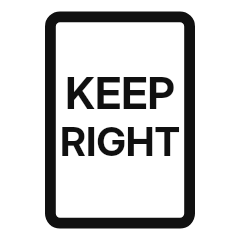
11. Where is this sign normally installed?
Show answer
Answer A: At an island or other obstruction in the roadway, to show which side traffic must take
It is placed at a divider, island or fixed obstruction so that drivers approaching it know without hesitating which side to pass on.
-
12. Why is parking next to a fire hydrant or in a marked fire lane prohibited?
Show answer
Answer D: It would delay firefighters who need immediate access to the hydrant or the building
Fire hydrants and fire lanes must remain clear at all times so emergency crews can connect hoses and reach a building without delay.
-
13. An arrow panel at a work zone displays a flashing arrow pointing to the left. What does it require?
Show answer
Answer C: Move out of the closed lane into the lane on the left
A flashing or sequential arrow on an arrow panel directs traffic out of a closed lane and into the lane the arrow points to.
-
14. How many BMV points does willfully fleeing or eluding a law enforcement officer carry in Ohio?
Show answer
Answer C: 6 points
Ohio assesses 6 points for willfully fleeing or eluding a law enforcement officer, placing it among the most serious point violations.
-
15. A funeral procession with headlights on is crossing an intersection when your light turns green. What should you do?
Show answer
Answer A: Wait and let the whole procession go through
Most states let a funeral procession stay together once the lead vehicle has lawfully entered an intersection, and in every state you must yield to vehicles already in the intersection, so wait until the line has passed.
-
16. You have entered a work zone where crews are working close to the open lane. What should you do?
Show answer
Answer A: Slow down and be ready for workers and machines
Workers and equipment cross the open lane without warning in a work zone, so reduced speed and attention on the road ahead are what keep them safe.
-
17. An Ohio TIPIC holder is age 18 or older. Under what condition may this person practice driving?
Show answer
Answer D: Only if accompanied by a licensed driver age 21 or older
Ohio requires a TIPIC holder age 18 or older to practice driving only while accompanied by a licensed driver who is at least 21 years old.
-
18. What does a posted speed limit sign represent?
Show answer
Answer B: The maximum speed permitted under ideal conditions
A speed limit is an upper limit that assumes good weather, good visibility and light traffic, so the safe speed is often lower than the posted figure.
-
19. What injury does a correctly set head restraint help prevent?
Show answer
Answer A: A neck injury of the kind caused when your vehicle is struck from behind
In a rear impact the body is pushed forward and the head restraint stops the head from whipping backward.
-
20. The street you are turning right onto has a bike lane along its right edge. Where should your vehicle end up?
Show answer
Answer B: In the first traffic lane to the left of the bike lane
A bike lane is not a travel lane for motor vehicles, so the nearest lane you may finish a right turn in is the first general traffic lane beside it.
-
21. What do the numbers on a pedestrian countdown display show?
Show answer
Answer A: The seconds remaining to finish a crossing already under way
The countdown runs during the pedestrian change interval and shows how many seconds are left before the crossing time ends.
-
22. What is the penalty for a first Ohio distracted driving offense within two years for a driver aged 18 or older?
Show answer
Answer B: 2 points and a fine of up to $150, avoidable by completing a distracted driving course
A first Ohio offense carries two points and a fine of up to $150, and completing a distracted driving course can avoid both the fine and the points.
-
23. An Ohio driver commits a third or later uninsured-driving violation within one year and receives a Class B suspension. For how many days is a court barred from granting limited driving privileges?
Show answer
Answer C: 30 days
Ohio law bars a court from granting limited driving privileges during the first 30 days of a Class B financial responsibility suspension, imposed for a third or later uninsured-driving violation within a year.
-
24. You come upon a person riding a horse on the roadway ahead of you. What is the correct way to pass?
Show answer
Answer A: Slow down, give plenty of room and do not use the horn
Horses startle easily, and a frightened horse can throw its rider into your path. Pass slowly and wide, and avoid any sudden noise.
-
25. Travelling at about 55 mph on dry pavement, roughly how much room does an average car need to perceive, react and stop?
Show answer
Answer D: About 300 feet, close to the length of a football field
Reaction distance plus braking distance at 55 mph comes to roughly 300 feet on good dry pavement, and considerably more on a wet or loose surface.
-
26. The motorcyclist ahead of you keeps moving from one side of the lane to the other. What should you understand?
Show answer
Answer B: The rider is avoiding surface hazards and staying where drivers can see the bike
Riders shift their lane position to avoid debris, grease strips and potholes and to be seen. That movement is normal and never an invitation to share the lane.
-
27. Why is following distance measured in seconds rather than in car lengths?
Show answer
Answer A: Because a time gap automatically grows with speed, while a fixed number of car lengths does not
A gap counted in seconds keeps the same margin of reaction time at any speed, whereas a fixed number of car lengths becomes far too small as speed rises.
-
28. You have parked a manual transmission car facing downhill. Which gear should you leave it in?
Show answer
Answer D: Reverse, along with the parking brake set firmly
Facing downhill the car would roll forward, so reverse gear opposes that movement while the parking brake and turned wheels back it up.
-
29. On a two-lane road with a broken yellow center line, may you cross it to turn into a driveway on the left?
Show answer
Answer C: Yes, when it is safe and the oncoming lane is clear
A broken center line may be crossed for a pass or for a left turn into a road or a driveway, once the oncoming lane is clear.
-
30. The green arrow protecting your turn changes to a steady yellow arrow. What is it telling you?
Show answer
Answer A: The protected turn is ending and you should prepare to stop
A steady yellow arrow warns that the arrow movement is being terminated and that a red indication will follow.
-
31. A yellow sign shows a truck on a slope with the legend 7 PERCENT GRADE. What should a driver of a heavy vehicle do?
Show answer
Answer A: Select a lower gear before starting down
The percentage shows how steep the descent is, and choosing a low gear at the top lets the engine hold the vehicle back instead of the brakes overheating.
-
32. Is it acceptable to watch a video on a screen positioned where you can see it while driving?
Show answer
Answer B: No, the screen pulls your eyes and attention away from the road
Moving pictures are among the strongest visual distractions. Video screens must be out of the driver's view while the vehicle is moving.
-
33. When may a driver of a motor vehicle use a marked bicycle lane?
Show answer
Answer C: Only to cross it when turning or entering the road where the markings allow
A bike lane is a lane for cyclists. Motor vehicles may only cross it to enter or leave the road or to make a turn where the markings permit.
-
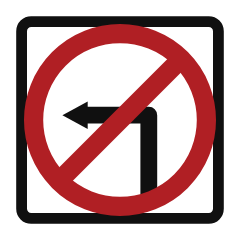
34. A driver in the leftmost lane reaches this sign at an intersection. What must the driver do?
Show answer
Answer B: Go straight on or turn right, and reach the destination another way
The restriction holds whatever the traffic or the signal is doing, so the driver has to pass the intersection and plan a different route.
-
35. A sign showing a walking figure inside a red circle with a diagonal slash stands at the start of a bridge. What does it mean?
Show answer
Answer C: People on foot may not use that roadway
The no pedestrians sign excludes people on foot from that roadway altogether, which is common on high-speed bridges and freeways.
-
36. At what blood-alcohol concentration does an Ohio OVI charge become a high-tier offense carrying enhanced penalties?
Show answer
Answer D: 0.17 percent or more
Ohio law treats a blood-alcohol concentration of 0.17 percent or more as a high-tier OVI, subject to enhanced sentencing beyond the standard 0.08 percent offense.
-
37. An Ohio school bus stops with red lights flashing on a road with fewer than four lanes. What must approaching drivers do?
Show answer
Answer D: Traffic from both directions must stop at least 10 feet from the bus
On an Ohio road with fewer than four lanes, traffic from both directions must stop at least 10 feet from the front or rear of the bus; on roads of four or more lanes only traffic going the same way must stop.
-
38. You reach a one-lane bridge and a vehicle is already partway across it coming toward you. What should you do?
Show answer
Answer D: Stop before the bridge and let it come through
A vehicle already on a one-lane bridge has the right of way, and the driver who has not yet entered waits at the approach.
-
39. You realize you have driven several miles without remembering any of it. What kind of distraction is this?
Show answer
Answer C: Cognitive distraction, because your mind was not on driving
Daydreaming or being lost in thought is a cognitive distraction. Your eyes may be on the road, but your brain is not processing what they see.
-
40. Besides an insurance policy or a liability bond, what document can an Ohio vehicle owner use to demonstrate proof of financial responsibility?
Show answer
Answer D: A certificate of self-insurance
Ohio law recognizes a certificate of self-insurance, typically used by large fleet owners, as an accepted form of proof of financial responsibility alongside insurance policies and bonds.