
Ohio BMV Motorcycle Practice Test 5
Test 5 of 6. Pick an answer for each question to see if it is right and why; your score appears at the end. You need 30 correct answers to pass, the same ratio as the real Ohio test.
- Questions40
- Correct to pass30
- Passing score75%
- Minimum age15 years 6 months
-
1. What happens when an Ohio driver reaches six points within a two-year period?
Show answer
Answer B: The BMV sends a six-point warning letter
At six points in two years the Ohio BMV mails a warning letter; the suspension and the SR-22 filing come only at 12 or more points.
-
2. Your right-turn lane shows a green arrow while the through lanes face a red ball. What does that mean?
Show answer
Answer C: Only the right turn is allowed, and it is protected while the arrow lasts
A green arrow gives a protected movement in that direction only; the red ball still stops the through traffic in the other lanes.
-
3. You are in the open lane where another lane is merging into yours. What is your part in the merge?
Show answer
Answer A: Keep a steady speed and leave a gap for one vehicle to come in
A merge works when each driver in the through lane lets one vehicle in, which keeps both lines moving instead of stopping them both.
-
4. Outside a municipal corporation, and apart from freeways, expressways, or a specially declared two-lane state route, what is Ohio's default prima facie speed limit on a highway?
Show answer
Answer D: 55 miles per hour
Ohio Revised Code 4511.21 sets 55 mph as the default prima facie speed limit for highways outside municipal corporations that are not covered by a more specific freeway, expressway, or declared limit.
-
5. If an Ohio driver is convicted of two offenses arising from the same crash and both carry BMV points, how does the bureau assess the points?
Show answer
Answer B: It adds the points from both convictions together
When two or more offenses from the same facts each carry points, Ohio charges points only for the offense with the greater point value rather than stacking them.
-
6. How should a passenger behave through a turn?
Show answer
Answer B: Look over the operator's shoulder in the direction of the turn and avoid sudden movement
Looking over the operator's shoulder into the turn keeps the passenger aligned with the motorcycle, and avoiding sudden movement prevents unexpected changes in balance.
-
7. May you stop briefly across the sloped ramp that joins the sidewalk to the street at a corner?
Show answer
Answer B: No, that ramp must stay clear for people using wheelchairs
A curb ramp is the only way many people can get from the sidewalk to the crosswalk, so blocking it even briefly is prohibited.
-
8. On a narrow residential street, why does parking tight against the curb matter so much?
Show answer
Answer C: Because fire trucks and ambulances need the width to get through
Cars parked even a foot out from the curb on both sides can narrow a street until a fire truck or ambulance cannot pass.
-
9. You will leave your vehicle for several hours after dark. Where is the best place to park it?
Show answer
Answer D: In a well-lit spot with people and cameras nearby
Light, passing people and cameras all discourage theft and make your own return to the vehicle safer.
-
10. What should a rider understand about the horn on a motorcycle?
Show answer
Answer A: It is often weak and may not be heard, so it never replaces an escape route
A small horn competes with a closed car, a radio and traffic noise, so a rider plans a way out instead of trusting the horn to be heard.
-
11. How far ahead of a turn does Ohio's official driving guidance say a driver should signal?
Show answer
Answer A: At least 100 feet ahead of the turn
Ohio's official driving guidance calls for signaling a turn at least 100 feet ahead of the intended turn.
-
12. You are approaching a narrow bridge where the road has one lane in each direction and no shoulder. What should you do about passing?
Show answer
Answer B: Do not pass on or near the bridge
A narrow bridge gives neither vehicle anywhere to go, so passing is prohibited there in the same way as on a hill or in a tunnel.
-
13. For a standard first-time Ohio OVI suspension, how many days must generally pass before a court may grant the offender any limited driving privileges?
Show answer
Answer D: 15 days
For a standard first OVI suspension, Ohio courts generally may not grant limited driving privileges during the first 15 days, after which privileges may be allowed, often with an ignition interlock requirement.
-
14. How long is an Ohio motorcycle TIPIC valid?
Show answer
Answer D: One year from the date of purchase
The Ohio motorcycle TIPIC is valid for one year from purchase, and if it expires the applicant must start the process again.
-
15. How many BMV points are assessed in Ohio for failing to stop and disclose identity at the scene of a crash?
Show answer
Answer D: 6 points
Ohio assesses 6 points for a hit-skip violation, that is, failing to stop and disclose identity after a crash.
-
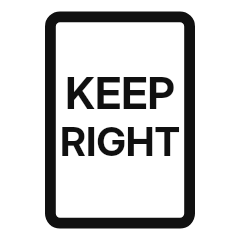
16. Where is this sign normally installed?
Show answer
Answer A: At an island or other obstruction in the roadway, to show which side traffic must take
It is placed at a divider, island or fixed obstruction so that drivers approaching it know without hesitating which side to pass on.
-
17. This sign comes into view ahead of a driver who has already started along a ramp. What should the driver do?
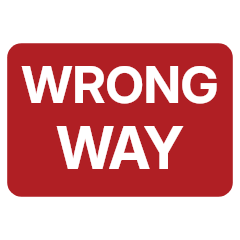
Show answer
Answer B: Pull clear where it is safe, then turn around and leave the ramp traveling properly
The driver is traveling against the legal flow, so the safest response is to stop clear of the lanes, turn the vehicle around and get off the ramp before meeting traffic head on.
-
18. What does a posted speed limit sign represent?
Show answer
Answer B: The maximum speed permitted under ideal conditions
A speed limit is an upper limit that assumes good weather, good visibility and light traffic, so the safe speed is often lower than the posted figure.
-
19. When downshifting as the motorcycle slows, what keeps the rear tire from skidding?
Show answer
Answer A: Easing the clutch lever out smoothly instead of releasing it abruptly
Letting the clutch out gradually lets engine speed and road speed match, so the rear wheel is not forced to slow suddenly.
-
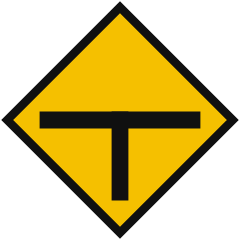
20. On which approach is this sign normally installed?
Show answer
Answer C: On the road that ends, far enough ahead for the driver to slow down
The warning belongs on the approach that terminates, placed early enough that the driver can lose speed and choose a direction before reaching the junction.
-
21. You enter a work zone at night where one lane is closed and a flagger is on duty. What is the safest approach?
Show answer
Answer A: Slow early, merge before the closure and be ready to stop
Merging early at a reduced speed keeps the queue orderly and leaves you room to stop for equipment, workers or traffic that has halted ahead.
-
22. How many motorcycles may ride side by side in a single lane in Ohio?
Show answer
Answer A: Not more than two
Ohio law permits not more than two motorcycles to ride side by side in one lane, and gives motorcycle operators the right to full use of the traffic lane.
-
23. What is the correct way to secure a load on a motorcycle?
Show answer
Answer C: Fasten it with elastic cords using several attachment points and check it at every stop
Several attachment points hold the load tight so it cannot shift or fall into the wheel or the chain, and checking at stops catches a load that has worked loose.
-
24. When are the hazard warning lights properly used?
Show answer
Answer A: When your vehicle is stopped or barely moving and is a hazard
Hazard lights warn that your vehicle is an obstruction; they do not authorize illegal parking and they hide your turn signals while driving.
-
25. Under Ohio law, an offender with three or four prior OVI convictions within 10 years, or five or more within 20 years, who is convicted again is guilty of what level of offense?
Show answer
Answer C: A fourth-degree felony
Ohio elevates a repeat OVI offense to a fourth-degree felony once an offender has three or four prior convictions within ten years, or five or more within twenty years, carrying a mandatory prison term.
-
26. What is the best way to handle fatigue on a long ride?
Show answer
Answer C: Take rest breaks regularly and dress to keep wind and cold out
Wind, vibration and cold tire a rider faster than a driver, and the safe answer is planned breaks and protective clothing rather than pressing on.
-
27. You have begun to move into the next lane when the gap you were aiming for closes. What is the safest action?
Show answer
Answer C: Return to your own lane, cancel the signal and wait for a better gap
An unfinished lane change leaves you in a space that no longer exists, and the lane you came from is still yours.
-
28. You are approaching a blind right hand curve. Which starting lane position gives the best view through it?
Show answer
Answer C: The left portion of the lane, toward the outside of the curve
Starting at the outside of a curve opens up the line of sight through it, and the rider then moves toward the inside as the exit comes into view.
-
29. Which action makes a wobble worse instead of better?
Show answer
Answer A: Braking or accelerating to try to ride out of it
Braking or adding power during a wobble can amplify it. Close the throttle gradually, hold the bars firmly and let the speed fall until the machine settles.
-
30. You make eye contact with a driver waiting to pull out of a side street. What should you assume?
Show answer
Answer D: The driver may still not have seen you, so stay ready to slow or stop
Drivers can look directly at you and still not register your vehicle, especially a small one. Eye contact helps, but never rely on it.
-
31. Is it acceptable to leave your vehicle across the entrance of an alley for a short time?
Show answer
Answer A: No, the entrance must stay clear at all times
Blocking an alley entrance traps the vehicles inside and can keep emergency services out, so it is prohibited however brief the stop.
-
32. In Ohio, what is the maximum lawful blood-alcohol concentration for a driver who is under 21?
Show answer
Answer B: 0.02 percent
Ohio sets 0.08 percent for drivers of any age, 0.04 percent for commercial drivers and 0.02 percent for drivers under 21.
-
33. You signaled a lane change and the signal did not switch itself off afterwards. Why does that matter?
Show answer
Answer B: Other drivers may act on a turn you do not intend to make
A signal left on tells other drivers you are about to turn, and someone may pull out in front of you. Cancel it as soon as the maneuver is finished.
-
34. Under Ohio law, driving faster than what speed in a non-business-district portion of a municipal corporation is automatically a fourth-degree misdemeanor, regardless of the driver's prior record?
Show answer
Answer B: 50 miles per hour
Ohio Revised Code 4511.21 automatically classifies speeding faster than 50 mph in a non-business-district portion of a municipal corporation as a fourth-degree misdemeanor, even for a first offense.
-
35. What should a rider remember about convex mirrors?
Show answer
Answer B: They show a wider view, but vehicles look farther away and slower than they are
The curved glass fits more of the scene into the mirror, and the price of that extra width is a distorted sense of distance and closing speed.
-
36. A driver ahead brakes for no reason you can see, again and again. What should you do?
Show answer
Answer B: Increase your following distance and be ready for yet another stop
Unexplained braking tells you the driver is unsure or distracted, so the safe answer is more room, not less.
-
37. A large truck ahead of you swings toward the left just before turning right at an intersection. What should you do?
Show answer
Answer B: Stay back and never try to move into the gap between the truck and the curb
Long vehicles need extra room and often swing wide to complete a right turn, so the space that opens on their right closes again as the trailer sweeps through it.
-
38. What kind of sole and heel suit motorcycle boots?
Show answer
Answer A: A hard, slip resistant sole with a low heel that will not catch
Boots have to grip the pavement when you put a foot down and grip the footrests while you ride, and a tall heel can catch on the ground or on the machine.
-
39. A turn restriction sign at the corner shows a range of times below the symbol. What does that mean?
Show answer
Answer A: The turn is banned only during the hours shown on the sign
Times posted under a regulatory symbol set the period during which the restriction applies; outside those hours the movement is permitted.
-
40. You have just returned to your own lane after passing. Why should you not slow down straight away?
Show answer
Answer A: The vehicle you passed is close behind and needs room to stop
Returning and then braking leaves the driver you just overtook with almost no following distance, which is how a pass turns into a rear-end collision.