
Ohio BMV Permit Practice Test 11
- Questions40
- Correct to pass30
- Passing score75%
- Minimum age15 years 6 months
-
1. A child in the back seat unfastens a seat belt while you are on the freeway. What should you do?
Show answer
Answer A: Pull off safely and refasten the belt
Turning or reaching back takes your eyes and hands off a high speed task, so leave the freeway or use the shoulder only if there is no exit, then fix the belt.
-
2. The left-turn signal facing you shows a flashing yellow arrow. What does it mean?
Show answer
Answer C: You may turn left after yielding to oncoming traffic and to pedestrians
A flashing yellow arrow permits a left turn but gives no protection, so you must yield to oncoming vehicles and to people in the crosswalk.
-
3. A yellow sign reads SOFT SHOULDER. What is it telling you?
Show answer
Answer C: The shoulder may not carry the weight of a vehicle
A soft shoulder is unpaved and can let a wheel sink, so a driver who leaves the pavement there may lose control or become stuck.
-
4. Which headlight setting should you use in dense fog?
Show answer
Answer B: Low beams
High beams reflect off the water droplets in fog and bounce glare back at you, while low beams aim downward and light the road without that mirror effect.
-
5. Your engine stalls while you are driving in traffic. What is the correct response?
Show answer
Answer A: Shift to neutral, try to restart it, and steer and brake toward the side of the road
With the engine off, power steering and power brake assistance fade, so steering and braking take more effort but still work. Neutral lets you attempt a restart while you coast to safety.
-
6. A hot drink tips over onto your lap while you are driving. What should you do?
Show answer
Answer A: Keep hold of the wheel and stop when it is safe
The spill is painful but the crash risk comes from letting go of the wheel or braking suddenly, so keep control and deal with it once you are stopped.
-
7. On a multi-lane street, a yield line is painted well back from an unsignalized crosswalk rather than right at it. Why?
Show answer
Answer D: So drivers in the other lanes can see the pedestrian
Setting the yield line back keeps a stopped vehicle from hiding a crossing pedestrian from drivers in the next lane, which is a common cause of these crashes.
-
8. You are driving on an open highway in a strong crosswind. What is the safest adjustment?
Show answer
Answer A: Reduce speed and keep a firm grip, expecting gusts on bridges and beside large vehicles
Gusts hit hardest in open gaps, on bridges and when passing high-sided vehicles, so a lower speed and a firm grip let you correct before you are pushed out of your lane.
-
9. A barricade carries a sign reading ROAD CLOSED TO THROUGH TRAFFIC. What does it permit?
Show answer
Answer B: Local access for people whose destination is on that road
This closure keeps out drivers who are only passing through while still allowing residents and deliveries to reach addresses within the closed section.
-
10. The lights at a highway-rail grade crossing begin to flash red as you approach. What must you do?
Show answer
Answer B: Stop short of the tracks and wait until the lights stop and no train is near
Flashing red lights at a crossing require a stop clear of the tracks, and you may proceed only once the lights have stopped, any gates are fully raised and no train is approaching.
-
11. You are starting from a stop on a snowy, icy street and the drive wheels begin to spin. What should you do?
Show answer
Answer C: Ease off the accelerator and start again more gently
Spinning tires polish the surface and dig in. Very gentle pressure on the accelerator, and a higher gear if you have one, gives the tires the best chance to grip.
-
12. What condition does this sign warn a driver about?
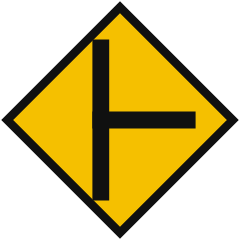
Show answer
Answer B: Another road joins the road being traveled, from one side
It announces a side road entering the main roadway, so the driver should expect vehicles waiting to pull out and other vehicles slowing to turn in.
-
13. Why is following distance measured in seconds rather than in car lengths?
Show answer
Answer A: Because a time gap automatically grows with speed, while a fixed number of car lengths does not
A gap counted in seconds keeps the same margin of reaction time at any speed, whereas a fixed number of car lengths becomes far too small as speed rises.
-
14. A truck ahead of you is spreading salt or grit on the road. What should you do?
Show answer
Answer B: Drop back so the material does not reach your car
Spreaders throw material backward and sideways, and following close means stone chips and a screen full of spray, so leave extra distance.
-
15. Why is a shoulder check especially important on a road with motorcycles and bicycles?
Show answer
Answer D: A narrow vehicle can disappear completely in the blind spot
A motorcycle or a bicycle is small enough to be hidden entirely by a door pillar or by the blind spot the mirrors do not cover.
-
16. A city transit bus at a stop ahead of you switches on its left signal. What should you do?
Show answer
Answer D: Slow and let the bus pull back into traffic
A bus needs a long gap to rejoin traffic, and yielding to a signaling transit bus keeps the whole line of traffic moving safely.
-
17. Why are tall vehicles such as SUVs and vans at extra risk in sudden steering maneuvers?
Show answer
Answer B: Their higher center of gravity makes them more likely to roll over
The higher a vehicle's mass sits, the more it leans in an abrupt turn, and a sharp swerve can tip it over. Smooth, gradual steering inputs are essential in tall vehicles.
-
18. What is the rule about leaving a child or a pet in a parked vehicle?
Show answer
Answer A: Never do it; the inside can turn deadly hot very quickly
The inside of a parked vehicle heats far faster than the air outside, and cracking a window does not prevent it, so a child or animal must never be left there.
-
19. What does it mean to scan the road while driving?
Show answer
Answer A: Moving your eyes constantly over the road, the sides and the mirrors
Scanning keeps information coming in from every direction, while a fixed stare leaves you blind to everything else.
-
20. You find that the road surface has turned to sheet ice. What speed is appropriate?
Show answer
Answer A: A crawl, slow enough that you could stop without braking hard
Ice can cut grip to a fraction of normal, so stopping takes many times the usual distance and only a crawl leaves any margin.
-
21. What must you be sure of before you pull out to pass on a two-lane road?
Show answer
Answer A: That the road ahead is clear far enough for the whole pass
You need enough clear road to pull out, pass and return before any oncoming vehicle arrives, and you must judge that distance before you start.
-
22. You drive onto a section where the top layer has been milled off and the surface is grooved. How will it feel?
Show answer
Answer C: The steering may wander, so hold the wheel firmly and slow down
Grooves cut into the pavement tug at the tires and make the steering feel restless. A firm grip and a lower speed keep the vehicle tracking straight.
-
23. You have just driven through a deep puddle and your brakes feel weak. What should you do?
Show answer
Answer D: Drive slowly while lightly applying the brakes until they dry and work normally
Wet brakes grip poorly and may pull to one side. Gentle braking at low speed generates heat that dries the pads and discs quickly.
-
24. You come up behind a group of cyclists riding two abreast on a narrow rural road. What should you do?
Show answer
Answer A: Wait for a clear stretch and pass them as one group
Passing a group as a single unit when the way ahead is clear is safer than several rushed passes, and cutting through the group leaves nobody any escape room.
-
25. Why are pedestrians and cyclists a special risk on unlit streets at night?
Show answer
Answer A: Dark clothing can make them invisible until they are very close
A person in dark clothing reflects almost no light and may not appear until they are inside your stopping distance, so cut your speed where people may be about.
-
26. An Ohio driver's vehicle is damaged in excess of $400 in a crash, and the other driver had no insurance. Within how long after the crash may this driver file a BMV Crash Report, form BMV 3303, documenting that fact?
Show answer
Answer B: Six months
Ohio allows a driver to file a Crash Report with the Bureau of Motor Vehicles within six months after a crash when damage exceeds $400 or there is personal injury, and the other party lacked insurance.
-
27. Why is it dangerous to make a left turn from the second lane from the center?
Show answer
Answer C: Because a driver in the lane beside you is turning into the same space
Drivers in the proper turn lane are entitled to that space, and turning across them puts two vehicles into one path through the intersection.
-
28. A deer suddenly steps onto the road ahead of you at night. What is the safest response?
Show answer
Answer C: Brake firmly and stay in your lane rather than swerving
Swerving at speed often leads to a rollover or a head-on crash that is far worse than hitting the animal. Brake hard, hold your lane and expect more deer to follow.
-
29. You are already inside an intersection when you realize you should be in the lane beside you. What should you do?
Show answer
Answer C: Stay in your lane through the intersection and change lanes afterwards
Drivers in an intersection are watching for cross traffic and turning vehicles, so an unexpected sideways move there is easily missed.
-
30. A small yellow plaque showing a speed number below a curve warning sign gives
Show answer
Answer C: the speed recommended for the condition being warned about
The advisory speed plaque belongs to the warning series and states the speed judged safe for the condition ahead under good circumstances, not a regulatory limit.
-
31. Why does the situation ahead of this sign deserve extra care from a motorcyclist?
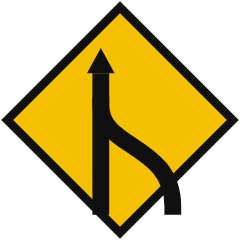
Show answer
Answer C: Because a narrow machine is easy to overlook in a mirror or a blind spot
A motorcycle fills very little of a mirror and disappears easily into a blind spot, so the rider should adjust speed and lane position to stay visible where the streams come together.
-
32. What do white lane lines painted between travel lanes indicate?
Show answer
Answer A: Traffic in the adjacent lane moves in the same direction as you
White markings separate lanes carrying traffic in the same direction and mark the right edge of the roadway.
-
33. Where is passing prohibited even when no line is visible?
Show answer
Answer D: On a curve or near the crest of a hill, at intersections and at railroad crossings
Passing is prohibited wherever your view of oncoming traffic is blocked or where vehicles may cross your path, which includes hills, curves, intersections and rail crossings.
-
34. About how far behind a tractor-trailer does the driver's rear blind spot reach?
Show answer
Answer C: Around 30 feet
The area behind a large truck is hidden for roughly 30 feet, so a driver tucked in there cannot be seen at all.
-
35. What is the safest way to handle an unrestrained pet or a child who needs attention while you are driving?
Show answer
Answer D: Secure pets before the trip and pull over safely before attending to a child
A loose animal or an urgent situation in the back seat can capture a driver's attention completely, so restrain pets beforehand and stop in a safe place when someone needs help.
-
36. You are slowing to turn right at an intersection and a bicyclist is riding beside your right side in a bike lane. What should you do?
Show answer
Answer D: Let the bicyclist go through the intersection before you begin the turn
Turning across the path of a bicyclist who is going straight causes the classic right-hook crash. The rider continuing straight has the right-of-way over your turn.
-
37. A person in a wheelchair is traveling in the roadway because the sidewalk is blocked by construction. What should you do?
Show answer
Answer B: Pass slowly with plenty of room, or wait
A blocked sidewalk leaves the person no choice but the road, and a chair cannot move aside quickly, so pass wide and slow or wait for room.
-
38. A bus stopped at the corner hides the crosswalk you are about to turn across. What should you do?
Show answer
Answer C: Turn slowly, ready to stop for anyone stepping out in front of it
People often step into the road from in front of a stopped bus, so approach the hidden crosswalk slowly and be ready to stop.
-
39. A bicyclist is riding around a single-lane roundabout in the middle of the lane as you wait to enter. What is your duty?
Show answer
Answer C: Yield to the bicyclist just as you would to a car
A bicyclist using the roundabout is traffic like any other vehicle and has the same claim to the circulating lane.
-
40. You notice at night that one of your headlights has burned out. What should you do?
Show answer
Answer B: Get it replaced promptly, because other drivers may take you for a motorcycle
A single light makes your vehicle look narrower and further away, so other drivers misjudge you, and one light is also illegal.