
Ohio BMV Motorcycle Practice Test 26
- Questions40
- Correct to pass30
- Passing score75%
- Minimum age15 years 6 months
-
1. What counts as a complete stop at a stop sign?
Show answer
Answer C: The wheels stop turning before the stop line
A legal stop means the vehicle is no longer moving, made at the stop line or before entering the crosswalk or intersection.
-
2. Why do experienced riders cover the clutch lever and the brake lever in heavy traffic?
Show answer
Answer B: It shortens the time needed to react if they suddenly have to stop
With fingers already resting on the levers the rider skips the time it takes to reach for them, which shortens overall stopping distance.
-
3. A curb lane is marked BUS ONLY 7 AM TO 9 AM. What may the driver of a car do?
Show answer
Answer A: Use the lane outside those hours
A part-time bus lane is reserved only during the posted period, and outside it the lane serves general traffic like any other.
-
4. About how far behind a tractor-trailer does the driver's rear blind spot reach?
Show answer
Answer C: Around 30 feet
The area behind a large truck is hidden for roughly 30 feet, so a driver tucked in there cannot be seen at all.
-
5. A sign at the signal reads LEFT TURN ON GREEN ARROW ONLY. The ball turns green but no arrow appears. What may you do?
Show answer
Answer C: Wait, because your turn is allowed only while the arrow is showing
The sign removes the permissive turn, so the left is legal only during the green arrow and you must wait behind the line until it appears.
-
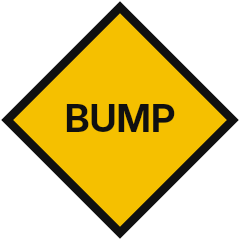
6. Why does this warning matter more on a motorcycle than in a car?
Show answer
Answer B: Because a sudden jolt can unsettle a two-wheeled machine and the rider can lose control
A jolt can push a motorcycle off line or lift a wheel, so a rider slows early, comes slightly off the seat and keeps a relaxed but firm hold on the handlebars.
-
7. In normal operation, which indication always comes between a green and a red on the same signal face?
Show answer
Answer C: A steady yellow
The yellow change interval must follow every green or green arrow, so a signal can never jump straight from green to red.
-
8. Why is a pothole a bigger problem for a motorcycle than for a car?
Show answer
Answer C: A motorcycle has only two wheels, so an impact can deflect it off line
A car crosses a hole on four wheels and stays balanced, while a hole can knock a motorcycle off its line or damage a wheel, so scan the pavement well ahead and plan a path around holes.
-
9. Why is hearing protection recommended even under a full face helmet?
Show answer
Answer D: Long term exposure to wind and road noise can cause permanent hearing damage
Airflow around a helmet produces high noise levels, and good hearing protection lowers that noise while still letting the rider hear horns and sirens.
-
10. How should a load be distributed between the two saddlebags?
Show answer
Answer B: Evenly, so the weight is balanced from side to side
An uneven load pulls the motorcycle toward the heavy side and makes it behave differently in left turns than in right turns.
-
11. A disabled vehicle is blocking your lane on a two-lane road with a single solid yellow line on your side. What should you do?
Show answer
Answer C: Wait until the oncoming lane is clear, then go around carefully
The solid line prohibits overtaking a moving vehicle, but in most states a driver may go around an obstruction such as a disabled vehicle once the oncoming lane is clear and the move can be made safely.
-
12. How should a rider approach a curve whose radius keeps tightening the further you go into it?
Show answer
Answer A: Enter more slowly than the curve first appears to need, saving lean for the exit
In a decreasing radius curve the sharpest part comes last, so a slower entry leaves both speed and lean angle in reserve for where they are needed.
-
13. What is a designated driver?
Show answer
Answer A: Someone who agrees to drink nothing at all
A designated driver drinks no alcohol whatsoever, because any amount begins to affect judgment and the whole point is a sober driver.
-
14. You are passing a tractor-trailer on a wet freeway and its wheels throw heavy spray. What is the best technique?
Show answer
Answer B: Increase your wipers and pass steadily without hesitating
Spray blinds you for as long as you stay beside the truck, so prepare the wipers first and then spend as little time in the spray as possible.
-
15. You have just ridden through a stretch of deep standing water. What should you do next?
Show answer
Answer B: Ride slowly and apply the brakes lightly to dry them out
Wet brakes can grab or barely work at all, and gentle pressure while moving slowly heats and clears them before they are really needed.
-
16. You realize at the last moment that you have passed the street where you meant to turn. What should you do?
Show answer
Answer D: Keep going and turn around where it is safe and legal
A missed turn is a minor inconvenience; braking suddenly, backing up or turning across traffic to recover it causes crashes.
-
17. You are approaching a horse and rider on a country road. What about your horn?
Show answer
Answer C: Do not sound it at all, because the noise can frighten the animal
A startled horse is dangerous to its rider and to you, so pass wide and slow and leave the horn alone.
-
18. In a tight, slow speed turn such as a parking lot U-turn, the rider should:
Show answer
Answer C: Lean the motorcycle while keeping the body upright
Keeping the body upright while the motorcycle leans lets the machine turn tightly and helps the rider hold balance at very low speed.
-
19. During a pre-ride check, what should the throttle do when it is released?
Show answer
Answer A: Snap back to the closed position on its own
A throttle that does not close by itself can leave the engine running fast when the rider expects it to slow, so a sticking cable must be repaired before riding.
-
20. Why should a rider avoid coasting to a stop with the transmission in neutral?
Show answer
Answer C: Engine braking is lost and so is the ability to accelerate out of trouble
Staying in gear keeps engine braking working and leaves the rider able to power away from a hazard instead of hunting for a gear first.
-
21. What is the purpose of the engine cut-off switch?
Show answer
Answer B: To stop the engine without letting go of the handgrips
The cut-off switch, usually a red switch near the right handgrip, shuts the engine down while the rider keeps both hands in control of the motorcycle.
-
22. The neutral light is on, but you are not sure the transmission is really out of gear. How can you confirm it?
Show answer
Answer B: Release the clutch and rock the motorcycle to see whether it rolls freely
A machine that rolls without resistance while the clutch is released is genuinely in neutral, which a burnt out or faulty neutral switch cannot tell you.
-
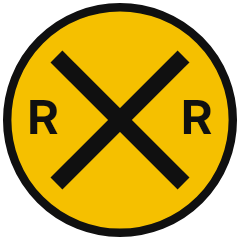
23. A driver sees this sign on a quiet road with no other traffic in either direction. What is the correct response?
Show answer
Answer C: Slow down, look and listen for a train, and be ready to stop
The sign gives advance notice of a highway-rail grade crossing, so the driver reduces speed, checks both directions along the tracks and keeps enough room to stop short of the rails.
-
24. The front brake lever feels soft and travels almost to the handgrip. What should the rider do?
Show answer
Answer D: Leave the motorcycle where it is until the brake system has been inspected
A spongy lever usually means air or fluid loss in the system, and a brake in that condition can fail completely under hard use.
-
25. You want to turn left at an intersection with no signs or signals and a vehicle is coming straight toward you from the opposite direction. What must you do?
Show answer
Answer C: Yield and turn after the oncoming vehicle has passed
A driver turning left always gives way to oncoming traffic that is close enough to be a hazard, whether or not the intersection is controlled.
-
26. Along a highway the reference markers count upward as you travel. Where does the numbering normally begin?
Show answer
Answer C: At the southern or western edge of the state
Mileage numbering starts where the route enters the state from the south or the west, so rising numbers tell a driver which way they are heading.
-
27. You want to pass on a two-lane road where several people are walking on the narrow shoulder ahead. What should you consider?
Show answer
Answer D: There is no escape room if the pass goes wrong, so wait for a better place
A pass depends on having somewhere to go if it goes wrong, and a shoulder occupied by pedestrians removes that option for both vehicles.
-
28. What is Ohio's speed limit in a school zone during recess and while children are arriving at or leaving school, when 20 mph school zone signs are posted?
Show answer
Answer A: 20 miles per hour
Ohio law sets a 20 mph prima facie speed limit in posted school zones during recess and the opening and closing hours when children are present.
-
29. A car is passing you on a two lane road. Which lane position is generally best while it goes by?
Show answer
Answer A: The center portion of your lane
The middle of the lane keeps distance from the passing vehicle and its mirrors while leaving room on the other side if the rider needs it.
-
30. You have turned right into the nearest lane but you need the left lane soon. When should you move over?
Show answer
Answer A: After the turn is finished, once you have checked mirrors and blind spot
Complete the turn in the proper lane first, then make a normal lane change with mirror and blind spot checks once you are established on the new street.
-
31. What is a microsleep?
Show answer
Answer D: A few seconds of sleep, sometimes with the eyes open
A microsleep is an involuntary lapse of a few seconds during which the driver is asleep and the vehicle travels blind, often without the driver knowing.
-
32. You enter a corner faster than the turn can be taken. What is the most likely result?
Show answer
Answer A: The vehicle runs wide and may cross into another lane
Excess speed uses up the available grip, so the vehicle follows a wider arc than intended and drifts out of its lane.
-
33. A deer crosses the road ahead of you and disappears into the trees. What should you expect?
Show answer
Answer A: More animals may follow, since deer usually move in groups
Deer commonly travel in groups, so one animal crossing is a warning that others are close by. Slow down and stay ready to stop well past the point where it crossed.
-
34. A vehicle is sitting in your blind spot and you need to change into that lane. What should you do?
Show answer
Answer B: Adjust your speed to open a clear gap, then check again and move over
Changing your speed either drops the other vehicle behind you or lets it move ahead, which turns the blind spot back into open space.
-
35. You come upon a crash that has just happened and decide to help. Where should you stop your vehicle?
Show answer
Answer A: Well beyond the scene, completely off the road, with the hazard lights on
Stopping past the crash and off the pavement keeps you from becoming another victim and leaves the approach clear for emergency vehicles.
-
36. What effect does low tire pressure have on a motorcycle?
Show answer
Answer C: It makes steering, braking and general handling worse
An underinflated tire changes shape under load, which makes the motorcycle steer heavily and respond unpredictably.
-
37. You are stopped at a stop sign waiting to turn onto a highway where traffic moves at 55 mph. How should you choose your gap?
Show answer
Answer A: Wait for a much larger gap than the one you would accept on a city street
Fast traffic covers ground while you are still accelerating, so the gap that feels adequate at 25 mph is dangerously short at highway speed.
-
38. What does it mean to ride the clutch?
Show answer
Answer C: Holding the lever part way in while riding, which wears the clutch plates
Cruising with the clutch partly disengaged makes the plates slip against each other, which wears them out and removes engine braking.
-
39. While you swerve around an obstacle, what should the rest of your body be doing?
Show answer
Answer C: Staying upright with the knees against the tank while the motorcycle leans
A swerve happens through the handlebars, and a body that stays still and anchored to the tank lets the motorcycle move quickly beneath the rider.
-
40. What matters most about the armor built into a riding jacket?
Show answer
Answer B: That it sits over the joints and stays there during a fall
Armor only works where it is, so the jacket must fit closely enough that the pads stay over the shoulders, elbows and spine when the rider hits the ground.