
Ohio BMV Motorcycle Practice Test 13
- Questions40
- Correct to pass30
- Passing score75%
- Minimum age15 years 6 months
-
1. You are about to pass another vehicle at night with your high beams on. What should you do?
Show answer
Answer C: Switch to low beams as you come up behind it and while you are alongside
High beams shining into the mirrors of the vehicle ahead blind the very driver whose reaction you depend on during the pass.
-
2. Which quality matters most in a face shield?
Show answer
Answer B: It resists penetration and is free of deep scratches
A shield has to stop objects thrown up from the road and stay clear enough for undistorted vision, and it needs some airflow so that it does not fog.
-
3. What is the main advantage of a face shield over goggles?
Show answer
Answer D: It protects the whole face, not only the eyes
Goggles keep wind and debris out of the eyes, but a shatter resistant face shield also protects the rest of the face in a crash.
-
4. The crossing gates begin to lower while your vehicle is still on the railroad tracks. What should you do?
Show answer
Answer B: Keep going forward and push through the gate if it should block your way
Gates are made to break away, and driving forward off the tracks is far safer than staying between them or backing up.
-
5. Where does a rider find the correct chain slack figure for a particular motorcycle?
Show answer
Answer B: In the owner manual for that motorcycle
Correct slack varies from model to model, so the manufacturer specification in the owner manual is the only reliable figure.
-
6. Your left-turn lane shows a flashing yellow arrow. What does that indication allow?
Show answer
Answer B: A left turn after yielding to oncoming traffic and to pedestrians
A flashing yellow arrow marks a permissive left turn: the movement is allowed, but oncoming vehicles and pedestrians keep the right-of-way.
-
7. What is the correct technique for a maximum effort stop in a straight line?
Show answer
Answer A: Squeeze the front lever progressively and press the rear pedal, staying upright
Both brakes together give the shortest stop, the front is squeezed progressively as weight transfers forward, and the machine must be upright with the bars square.
-
8. A loaded truck is coming up an entrance ramp as you approach in the right lane of the freeway. What is the most helpful action?
Show answer
Answer A: Adjust your speed to open a gap for it
A heavy vehicle accelerates slowly, so opening a gap or moving over costs you seconds and saves the truck driver from being forced to stop on the ramp.
-
9. In a work zone a flagger signals you to stop, but the sign beside the road says the lane is open. What should you do?
Show answer
Answer C: Obey the flagger
A flagger controls the work zone in real time and the instruction outranks the signs and markings, which cannot reflect what is happening at that moment.
-
10. You feel fine twenty minutes after your last drink. Why is that a poor guide to driving?
Show answer
Answer B: Your blood alcohol level can still be rising
Alcohol keeps being absorbed for some time after the last drink, so a driver who feels able at the door can be more impaired a few miles down the road.
-
11. You are waiting to enter a two-lane roundabout and traffic is circulating in both lanes. What must you do?
Show answer
Answer A: Yield to traffic in both circulating lanes before you enter
Every entry to a roundabout is a yield point, and at a two-lane roundabout that means giving way to vehicles in either circulating lane.
-
12. Your phone is in a mount on the dashboard rather than in your hand. What is true?
Show answer
Answer B: It still takes your eyes and mind off the road
A mount solves the hand problem but not the eye or the mind problem, and reading or tapping a mounted screen costs the same seconds of attention.
-
13. The throttle sticks open and will not close when you roll it back. What should you do?
Show answer
Answer B: Squeeze in the clutch and shut the engine down with the cut-off switch
Pulling in the clutch cuts power to the rear wheel immediately, and the cut-off switch stops the engine without the rider letting go of the handlebars.
-
14. The green arrow protecting your turn changes to a steady yellow arrow. What is it telling you?
Show answer
Answer A: The protected turn is ending and you should prepare to stop
A steady yellow arrow warns that the arrow movement is being terminated and that a red indication will follow.
-
15. How can you check that you are keeping a safe following distance?
Show answer
Answer A: Count at least three seconds between the vehicle ahead passing a fixed object and your reaching it
Pick a fixed roadside object, start counting when the vehicle ahead passes it and make sure at least three seconds elapse before you reach it, adding more time in poor conditions.
-
16. What happens when tires are driven underinflated for a long time?
Show answer
Answer D: They wear at the edges, they run hot and they are more likely to fail
An underinflated tire flexes too much, which wears the shoulders and builds up heat that can destroy the tire.
-
17. How is the yield sign shaped and colored?
Show answer
Answer C: A downward-pointing triangle with a wide red border and a red legend on white
The yield sign is a downward-pointing equilateral triangle with a wide red border and the legend in red on a white background, an outline used for no other message.
-
18. After turning right you see a sign showing that your lane ends a short way ahead. What should you do?
Show answer
Answer B: Signal and merge into the next lane while there is still room
Merge early and smoothly while a gap is still available, rather than running out of pavement or forcing your way in at the last moment.
-
19. The circular sign shape is reserved for which warning?
Show answer
Answer C: Advance warning of a highway-rail grade crossing
A round yellow sign with a black X and the letters RR is the grade crossing advance warning sign, and the circular outline is used for no other message.
-
20. About how far does a vehicle travel in one second at 60 mph?
Show answer
Answer A: About 88 feet
At 60 mph you cover about 88 feet every second, which is why a glance of only two or three seconds means driving the length of several vehicles blind.
-
21. A yellow horizontal rectangular sign showing one large arrow pointing left or right, facing traffic on the far side of a sharp bend, tells the driver
Show answer
Answer C: which way the roadway turns at that point
The large arrow sign is mounted on the outside of a sharp change in alignment so that a driver approaching head on immediately sees which way the road goes.
-
22. An overhead sign shows that the right lane is EXIT ONLY. What does that mean if you intend to stay on the highway?
Show answer
Answer B: You have to move out of that lane before the exit
An exit only lane leaves the highway completely, so a driver continuing on the highway has to change lanes before it does.
-
23. In a normal signal cycle, what comes after a steady red indication?
Show answer
Answer A: A green indication that starts the next movement
Yellow is a warning that a movement is ending, so it never precedes a green; a red is followed by a green or a green arrow.
-
24. A driver extends the left arm out the window and bends it upward at the elbow. What does this signal mean?
Show answer
Answer B: A right turn
The left arm bent upward at the elbow is the standard hand signal for a right turn.
-
25. You are stopped in traffic at a red light when an ambulance comes up behind you with its siren on. What is the correct action?
Show answer
Answer D: Stay put until you can move aside legally and safely
You must not run a red light or make an unsafe move to yield; wait, then pull to the side once the way ahead lets you do it safely.
-
26. You are in the right-hand lane of a multilane street and that lane becomes a right-turn-only lane ahead, but you want to go straight. What should you do?
Show answer
Answer B: Change into a through lane before you reach the markings for the turn lane
A lane-use arrow is a regulatory marking, so a driver who wants to continue straight has to leave that lane before it becomes a mandatory turn lane.
-
27. How can you keep space at the sides of your vehicle in heavy traffic?
Show answer
Answer D: Drive in the gaps between the other vehicles rather than beside them
Travelling in the open spaces rather than alongside others keeps a way out open on at least one side.
-
28. An orange sign reading END ROAD WORK is posted beside the highway. What does it mark?
Show answer
Answer C: The point where the work zone restrictions stop
The sign is installed at the downstream end of the temporary traffic control zone to tell drivers that normal conditions apply again.
-
29. A vehicle in the lane beside you has stopped at a crosswalk. What should you do?
Show answer
Answer C: Stop as well, because that driver may be yielding to a pedestrian you cannot see
The stopped vehicle hides the crosswalk from you, and passing it is a leading cause of collisions with pedestrians who are already crossing.
-
30. Why is passing another vehicle a bad idea in dense fog?
Show answer
Answer C: You cannot see far enough ahead to know the passing lane is clear
A pass needs a clear view of the road well beyond the vehicle you are overtaking, and fog takes exactly that away.
-
31. You are on a one-way street with two marked lanes. May you pass a slower vehicle on the right?
Show answer
Answer A: Yes, using the right lane, provided that the move is safe and signaled
On a roadway with two or more marked lanes in your direction, moving into the free lane and going by is a normal lane change rather than an unlawful pass.
-
32. Besides school signing, which warning signs may also use a fluorescent yellow-green background?
Show answer
Answer C: Pedestrian and bicycle warning signs
Pedestrian crossing, bicycle and playground warning signs may use either the standard yellow or the fluorescent yellow-green background, which draws extra attention where people outside vehicles are present.
-
33. You are wearing a high visibility jacket. How should that change the way you ride?
Show answer
Answer B: You still ride as though drivers have not seen you
Bright gear improves your odds of being noticed but guarantees nothing, so keep the lane position, space cushion and escape routes that protect you anyway.
-
34. You arrive at a four-way stop after two other vehicles have already stopped there. When is it your turn?
Show answer
Answer A: After both of the earlier vehicles have gone
Vehicles clear a four-way stop in the order they arrived, so the third driver to stop is the third to go.
-
35. The gates at a railroad crossing are down, and you can see that the road beyond them is clear. What is the correct action?
Show answer
Answer A: Wait until the gates rise completely and the lights go out
Lowered gates mean rail traffic is expected, and driving around them removes the only protection the crossing provides.
-
36. Which surfaces usually offer less grip than the pavement around them when wet?
Show answer
Answer B: Painted markings, metal plates and bridge decks
Paint, steel and bridge decks all shed grip when wet or cold, so brake before you reach them rather than on top of them.
-
37. What is the driver expected to do after passing this sign?
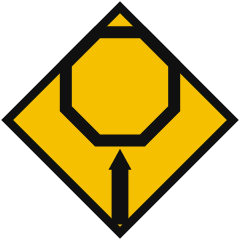
Show answer
Answer A: Begin slowing so that a complete stop can be made at the intersection ahead
It is used where the control at the intersection stays hidden until late, so braking should begin here rather than at the stop line.
-
38. An Ohio driver takes the chemical test after an OVI arrest and the result is over the limit, with no prior convictions. What administrative suspension applies?
Show answer
Answer D: Three months, or 90 days
Ohio imposes a three-month administrative license suspension for a first test over the limit; longer terms apply when there are prior OVI or drug convictions.
-
39. You want to turn right from a lane marked for through traffic and right turns, and the driver behind you wants to go straight. What should you do?
Show answer
Answer C: Signal, stay in the lane and make the turn when it is safe
A shared lane is the correct place to turn right from, so signal early and turn from the lane; the driver behind must wait or use another lane.
-
40. Where among these is parking specifically prohibited?
Show answer
Answer A: On a bridge, in a tunnel or on railroad tracks
Bridges and tunnels have no safe refuge and cannot be widened, and a vehicle left on railroad tracks cannot be avoided by an approaching train.