
Ohio BMV Permit Practice Test 17
- Questions40
- Correct to pass30
- Passing score75%
- Minimum age15 years 6 months
-
1. In near freezing weather, which part of an otherwise clear road is most likely to still be icy?
Show answer
Answer D: A shaded dip under trees or beside a rock cut
Sun clears most of the road, but shaded hollows never warm up and can hold ice long after the rest of the pavement is dry.
-
2. Two solid white lines separate your lane from the lane beside it. What do they mean?
Show answer
Answer B: Crossing from one lane to the other is prohibited
A solid double white line marks a boundary that road users may not cross, such as the entrance to a preferential lane.
-
3. When should headlights be switched on besides during the hours of darkness?
Show answer
Answer C: Whenever rain, fog, snow or dust makes it harder to see or to be seen
Headlights are as much about being seen as about seeing, so they go on whenever visibility drops.
-
4. Yellow signs each showing one large black arrowhead, installed in a row along the outside of a curve, are
Show answer
Answer D: chevron alignment signs marking the change of direction of the curve
Chevron alignment signs are placed on the outside of a curve so that several are in view at once, letting the driver judge how sharply the road turns.
-
5. You are backing a trailer and want its rear to move to the left. Which way should you turn the steering wheel?
Show answer
Answer A: Move the bottom of the wheel to the left, which turns the top to the right
A trailer moves opposite to the tow vehicle's steering when backing. Holding the wheel at the bottom and moving your hand in the direction you want the trailer to go makes this easier.
-
6. A city transit bus ahead of you has stopped at the curb with its passenger door open. What does the law require of you?
Show answer
Answer D: Nothing special, but pass slowly and watch for people
The mandatory stop applies to a school bus showing red flashing lights, not to a transit bus, though a careful driver still slows for crossing passengers.
-
7. A trailer that sways badly at speed is often loaded the wrong way. What is the usual fault?
Show answer
Answer A: Too much of the load sits behind the trailer axle
Weight behind the axle lightens the hitch and lets the trailer wag the vehicle. Most of the load should sit ahead of the axle to keep weight on the hitch.
-
8. The brake pedal goes to the floor and the vehicle does not slow. What should you try first?
Show answer
Answer C: Pump the pedal quickly to try to build pressure
Most vehicles have a split braking system, so rapid pumping can often build enough pressure to slow you. If it does not, use the parking brake gradually.
-
9. You feel drowsy, so you open a window and turn the radio up. What does that achieve?
Show answer
Answer B: Very little, because the drowsiness comes back
Cold air and loud music are not sleep, so the alerting effect lasts a minute or two and the driver is soon just as sleepy and closer to a lapse.
-
10. You are traveling a long distance on a highway with three lanes in your direction, at about the speed of the surrounding traffic. Which lane is generally the best choice?
Show answer
Answer C: The center lane, which keeps you clear of merging traffic and of overtaking traffic
On a three-lane roadway the center lane avoids both the ramp traffic on the right and the overtaking traffic on the left, so it usually has the steadiest flow.
-
11. You have printed directions or paperwork you need to check. When should you read them?
Show answer
Answer C: Before you leave, or after you park
Reading takes eyes and mind off the road for far longer than any safe glance, and a light that changes while you read leaves you moving off blind.
-
12. A parking space is marked with the international symbol of access. Who may use it?
Show answer
Answer A: Only a vehicle displaying the required placard or plate
Accessible spaces may be used only by a vehicle that displays a valid disability placard or plate, no matter how short the stop would be.
-
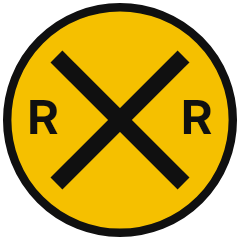
13. This sign leads to a crossing that has no gates and no flashing lights. What does that mean for the driver?
Show answer
Answer D: Nothing will warn of an approaching train, so the driver must check the tracks personally
At a passive crossing there is no active device to announce a train, so the whole judgment rests on the driver, who must approach slowly enough to stop after looking along the track.
-
14. What do the numbers on a pedestrian countdown display show?
Show answer
Answer A: The seconds remaining to finish a crossing already under way
The countdown runs during the pedestrian change interval and shows how many seconds are left before the crossing time ends.
-
15. An Ohio TIPIC holder under age 16 is practicing on a weekday afternoon. Who must occupy the front passenger seat?
Show answer
Answer D: A parent, guardian, custodian, licensed driving instructor, or a person 21 or older acting in loco parentis
Ohio requires a TIPIC holder under age 16 to be supervised at all times, not just at night, by a parent, guardian, custodian, licensed driving instructor, or a person 21 or older standing in for a parent.
-
16. A bicyclist ahead of you extends the left arm out with the forearm bent upward. What does that signal mean?
Show answer
Answer A: The bicyclist intends to turn right
Bicyclists use the same hand signals as drivers: left arm straight out means left, left arm bent up means right, and left arm bent down means stop or slow.
-
17. You are turning left out of a driveway onto a busy two-way street. What must you do?
Show answer
Answer D: Wait for a gap in both directions before you start to move
The turn crosses one direction of traffic and joins the other, so you need a gap in both before leaving the driveway rather than stopping across a lane.
-
18. A NO LEFT TURN sign carries a plaque reading 7 AM TO 9 AM MON TO FRI. What does the assembly mean?
Show answer
Answer A: The turn is banned only during those hours on those days
A time plaque limits the restriction to the periods shown, so outside those hours and days the left turn may be made normally.
-
19. An Ohio resident already holds a standard Class D driver license. Does this person need a separate moped license to legally ride a moped?
Show answer
Answer C: No, a moped license is not needed once a driver license has already been issued
Ohio does not require a separate moped license for someone who already holds a driver license, since the driver license already authorizes moped operation.
-
20. Under Ohio's Move Over law, once a passing driver complies by changing lanes or slowing down, is the stationary emergency or service vehicle relieved of any duty of care?
Show answer
Answer C: No, the stationary vehicle's own duty to drive with due regard for safety is not relieved
Ohio's Move Over statute expressly states that compliance by passing traffic does not relieve the stationary vehicle of its own duty to operate with due regard for the safety of all persons and property.
-
21. You are using the parking brake to slow a vehicle whose brakes have failed. How should you apply it?
Show answer
Answer D: Gradually, holding the release so you can let it off if the rear slides
The parking brake works on two wheels only, so applying it hard can lock them and spin the vehicle. Keep the release held so you can back it off instantly.
-
22. Why does safety guidance say a child should ride in the back seat rather than in front of an active passenger airbag?
Show answer
Answer D: Because the airbag inflates with enough force to injure a small child badly
Airbags deploy at very high speed and are sized for adults, so a child seated close to one can be badly hurt by the bag itself, which is why the back seat is recommended for children.
-
23. You are clear of the tracks after your vehicle stalled on a crossing. Whom should you contact?
Show answer
Answer C: The emergency number posted on the blue sign at the crossing, or 911
Grade crossings carry an emergency notification sign with a railroad phone number and a crossing identification number so that approaching trains can be stopped, and 911 works if that sign is not visible.
-
24. You are parking on a hill where there is no curb, whether facing up or down. Which way should the front wheels point?
Show answer
Answer B: Toward the shoulder, so the vehicle would roll away from the traffic lanes
With no curb to stop the vehicle, the wheels are turned toward the edge of the road so that a runaway vehicle leaves the roadway instead of entering it.
-
25. You want to turn left at an intersection with no signs or signals and a vehicle is coming straight toward you from the opposite direction. What must you do?
Show answer
Answer C: Yield and turn after the oncoming vehicle has passed
A driver turning left always gives way to oncoming traffic that is close enough to be a hazard, whether or not the intersection is controlled.
-
26. You are circulating in a roundabout and a vehicle is waiting to enter ahead of you. What should you do?
Show answer
Answer D: Keep going, because circulating traffic does not stop for entering vehicles
Stopping in the circle to be polite surprises the drivers behind you and defeats the design; entering traffic is the side that waits.
-
27. You cannot avoid a wide puddle that covers only the right half of your lane. What should you expect?
Show answer
Answer D: The water can tug the vehicle toward that side, so slow before it and grip the wheel
Water dragging on the tires of one side only pulls the vehicle that way. Reduce speed before you reach it and hold the wheel firmly.
-
28. You have stopped at a stop sign, but a parked truck blocks your view along the cross street. What should you do?
Show answer
Answer A: Creep forward slowly and stop again where you can see
When something blocks the view, a second stop closer to the intersection is the only safe way to see, and it must come before your vehicle enters the traffic lane.
-
29. Your light is green but the traffic beyond the intersection is stopped and there is no room on the far side. What should you do?
Show answer
Answer A: Wait behind the line until you can clear the far side
Entering an intersection you cannot clear blocks the cross traffic when their signal turns green, so you wait behind the line.
-
30. You are entering a marked school zone during the posted hours. What should you do?
Show answer
Answer A: Slow to the school zone limit and watch for children
The school zone limit applies throughout the posted hours, whether or not you can see any children at that moment.
-
31. Your right wheels drop off the edge of the pavement onto a soft shoulder. What should you do?
Show answer
Answer C: Ease off the accelerator, hold the wheel straight and steer back gently once you have slowed
Yanking the wheel while the tires are pressed against a pavement lip can throw the vehicle across the road, so slow down first and then make a gentle correction.
-
32. The divided highway ends warning sign means that
Show answer
Answer D: the median separating the directions ends and the road returns to two-way operation
Beyond this sign opposing traffic is no longer separated by a median, so the driver must keep right and expect vehicles approaching in the adjacent lane.
-
33. Two solid yellow lines are painted down the center of a two-way road. What do they mean?
Show answer
Answer B: Traffic in neither direction may cross them to pass
A double solid yellow line marks a no-passing zone that applies to traffic traveling in either direction.
-
34. How often should the spare tire be checked?
Show answer
Answer C: Regularly, because a spare loses pressure while it sits unused
Spares lose air slowly over months, and a flat spare is useless at the moment you need it.
-
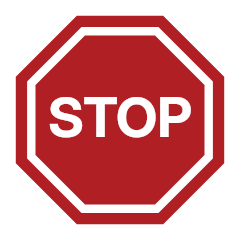
35. At an intersection where every approach carries this sign, two drivers arrive at exactly the same instant. Which of them goes first?
Show answer
Answer C: The driver on the right
Order of arrival decides who goes first, and when two vehicles arrive together the driver on the right proceeds while the other gives way.
-
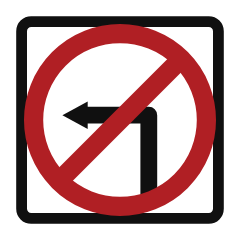
36. A driver in the leftmost lane reaches this sign at an intersection. What must the driver do?
Show answer
Answer B: Go straight on or turn right, and reach the destination another way
The restriction holds whatever the traffic or the signal is doing, so the driver has to pass the intersection and plan a different route.
-
37. You have passed a large truck and want to move back into its lane. What should you see first?
Show answer
Answer B: Both of its headlights in your rear-view mirror
Seeing both headlights in your mirror means you are far enough ahead to be out of the truck's front no-zone before you move over.
-
38. What is the most common cause of rear-end collisions?
Show answer
Answer C: Following too closely to stop in time
A driver who leaves too little space has no room to perceive, react and brake when the vehicle ahead slows, which is why space management prevents rear-end crashes.
-
39. What is the usual result of driving well above the flow of traffic on a typical trip?
Show answer
Answer B: Very little time saved, with much greater risk
Signals, traffic and short distances swallow the theoretical gain, while crash risk and crash severity both climb sharply with speed.
-
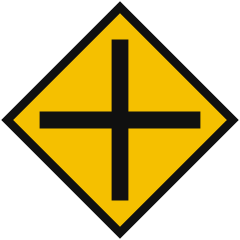
40. Does this sign settle who has the right-of-way at the intersection ahead?
Show answer
Answer D: No, it only gives notice of the intersection; the control there decides priority
A warning prepares the driver for what is coming but grants no priority, so whatever stop control, yield control, signal or right-of-way rule applies at the intersection is what decides.